Elasticsearch receiver
Takes what Elasticsearch clients send to Elasticsearch's Bulk API at its port. It answers each request once every destination has its documents.
Filebeat and the other Beats, Fluent Bit and other clients of the Bulk API send to it. Every worker in the group listens on its port, and the sender, or a balancer in front of the workers, picks a worker for each request. Add workers to take more.
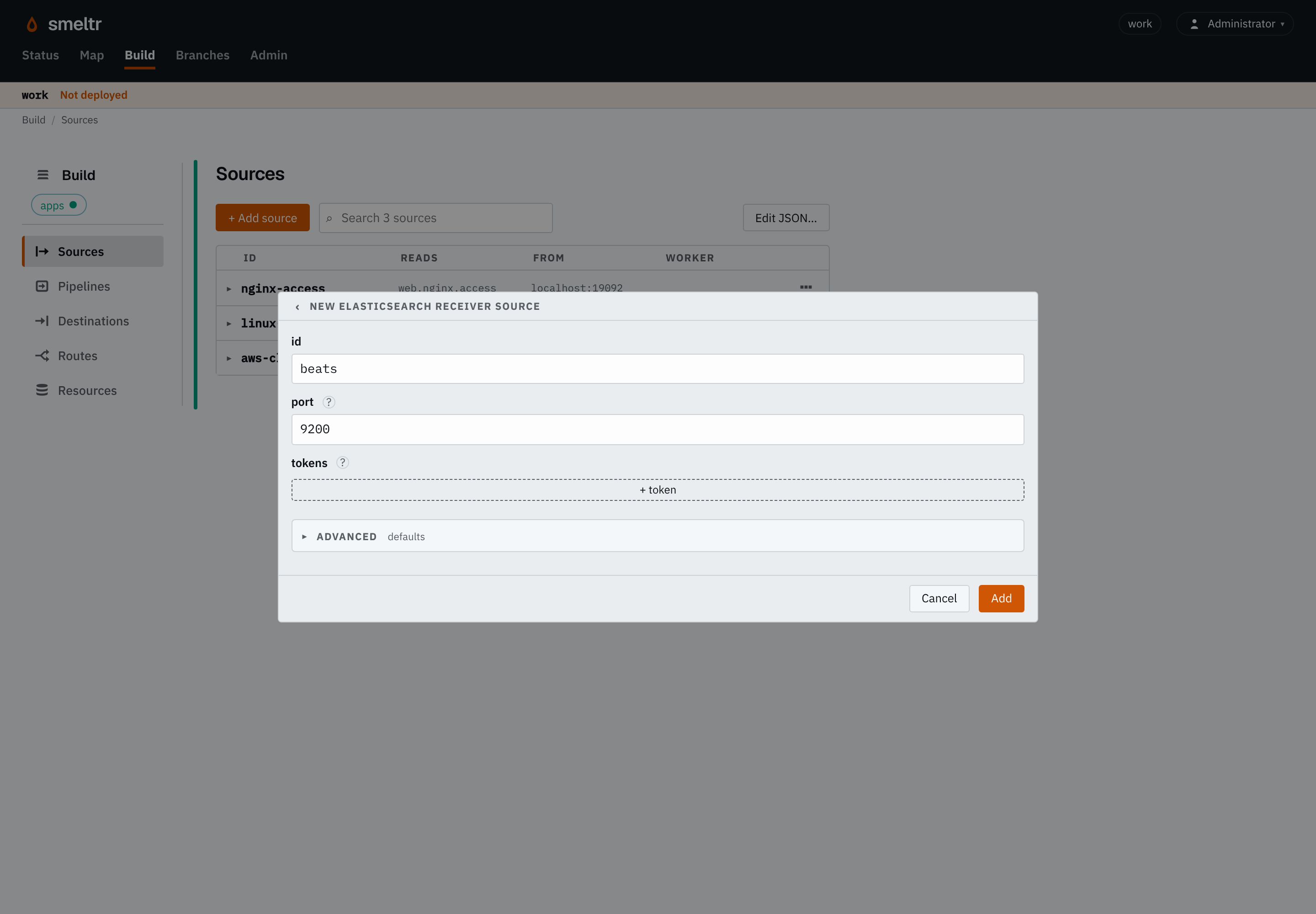
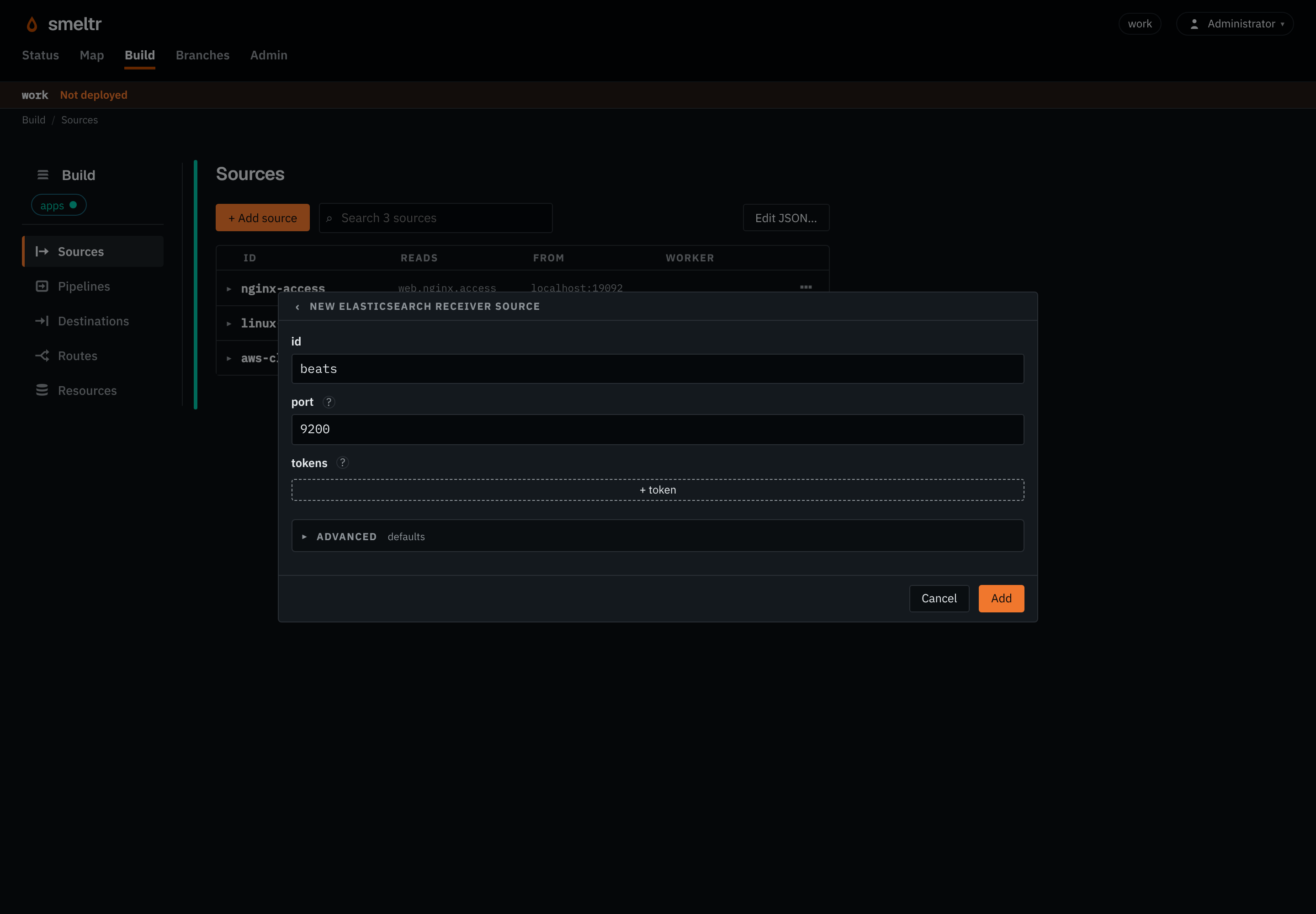
Example
Takes bulk requests on port 9200, over TLS with the identity receiver-tls. Senders present the
token held in the worker-host variable ES_TOKEN.
{
  "id": "beats",
  "type": "elasticReceiver",
  "port": 9200,
  "tokens": {
    "beats": "ES_TOKEN"
  },
  "identity": "receiver-tls"
}
Filebeat sends to it with an output.elasticsearch block like this, where ES_TOKEN holds an id:key such as beats:k3y, as the
receiver's credential does:
output.elasticsearch:
  hosts: ["https://workers.example.com:9200"]
  api_key: "${ES_TOKEN}"
  ssl.certificate_authorities: ["/etc/filebeat/smeltr-ca.pem"]
setup.template.enabled: false
setup.ilm.enabled: false
Before you start
- Pick a port no other receiver in the group uses, such as 9200.
- Turn off the sender's setup of index templates and lifecycle policies. The receiver holds
neither, and answers
404to a request for one. On a Beat, setsetup.template.enabled: falseandsetup.ilm.enabled: false. - Decide how senders prove who they are: a token, a client certificate, or both. See Tokens and certificates.
- Put each token in a credential.
- Open the port on every worker, and give senders one address that reaches them all. See Open its port.
Settings
It also takes the settings every source takes.
port integer required
The port it listens on. Every worker of the group binds it, so no two receivers share one.
920019200tokens map default none
Each token's name to the credential holding it. A sender presents one as Authorization: Bearer <token>, as ApiKey <token>, the key as sent or its id:key, or as a Basic password, and any other request is refused 401. A receiver with no token needs an identity with authorities.
beats = ES_TOKEN{"shippers": {"secret": "es-shippers","version": 1}}Advanced
identity identity default plain HTTP
The connection identity it serves TLS under: its certificate and key. With authorities, a sender must present a certificate that chains to one of them.
receiver-tlsmaxRequestBytes integer default 10485760
The largest request body it reads, between 1024 and 67108864. A larger one is refused 413, so set a sender's bulk size below it.
104857667108864Paths it serves
- POST or PUT
/_bulk,/{index}/_bulk - The body is a bulk request: newline-delimited JSON, plain or with
Content-Encoding: gzip. An action line names what to do, and theindex,createandupdateactions are followed by their document. An index in the path, and apipelinein the query, apply to each action that names none itself. - GET
/health - Says whether the receiver takes requests. See Health check.
Records it gives
Each index or create action's document becomes one record: the document
as it was sent. This request gives two records:
{"index":{"_index":"web","_id":"a1"}}
{"message":"GET /cart 200","host":"web-1"}
{"create":{"_index":"web"}}
{"message":"GET /cart 500","host":"web-2"}
The receiver takes no update or delete. Each is answered 400 in its own item, and the request's other actions are taken all the same. So is a
document that is not a JSON object.
Fields it gives
The index, _id and pipeline an action names for its document, or the
path and query name for it, ride with the record. A field the sender did not set is null. __source.remote holds the IP address the request came from: the balancer's, when one
is in front of the workers.
| Field | Type | Holds |
|---|---|---|
__source.name | str | The name of the source that read the record. |
__source.type | str | The kind of source that read it, its type, such as kafka, s3List, httpApi or hecReceiver. |
__source.remote | str | The address of the sender that delivered the record to a receiver. |
__source.index | str | The index a HEC sender filed the event under, or an Elasticsearch client's bulk action named for its document; null where it named none. |
__source.id | str | The _id an Elasticsearch client's bulk action named for its document, or null where it named none. |
__source.pipeline | str | The ingest pipeline an Elasticsearch client's bulk action, or its request's pipeline query, named for its document, or null where neither named one. |
__source.bytes | bytes | The record's payload as the source read it, before any decoding. The source decodes _raw from it. A bytes destination writes it unless the destination names another field. Text functions refuse it; decode(__source.bytes, encoding) reads it as text. |
Tokens and certificates
Anyone a receiver admits can put records into the group's pipelines, so a receiver needs tokens, an identity with authorities, or both. The leader refuses a receiver
with neither.
- Tokens: a sender presents one in any of these three ways. The receiver
refuses any other request before reading its body. Without an identity, the token crosses the
network in the clear, so use a token alone only behind a balancer that terminates TLS.
Authorization: Bearer <token>.Authorization: ApiKey <key>, a Beat'sapi_key. The credential holds either the key's base64 or itsid:key.- Basic, with the token as the password, Fluent Bit's
HTTP_Passwd. Any user name will do.
- Client certificates: with an identity, the receiver serves TLS with the identity's certificate and key. If the identity has authorities, every connection, health checks included, must present a certificate that chains to one of them.
With both, a sender presents a certificate and a token.
What it answers
The receiver answers success only once every destination has the request's documents, so a sender that retries an unanswered request loses nothing. Each refusal's body holds an error that says why in the reason field.
- 200
- Every destination has the request's documents. The body holds an item per action, in the order
sent:
201for each document taken, with the_idits action named or one the receiver made up, and400for each action not taken.{ "took": 3, "errors": false, "items": [ { "index": { "_index": "web", "_id": "a1", "_version": 1, "result": "created", "_shards": { "total": 1, "successful": 1, "failed": 0 }, "_seq_no": 0, "_primary_term": 1, "status": 201 } }, { "create": { "_index": "web", "_id": "GcEG4pVuTOAAAAAAAAAA", "_version": 1, "result": "created", "_shards": { "total": 1, "successful": 1, "failed": 0 }, "_seq_no": 0, "_primary_term": 1, "status": 201 } } ] } - 429, with
Retry-After - The receiver is full, blocked or stopping. A sender may send it again.
- 408
- The sender took more than 30 seconds to send the whole body.
- 401
- The request has no token, or gives one the receiver does not hold. See Tokens and certificates.
- 400
- The body holds no action, an action line does not read, an action has no document after it, or an action names no index and neither does the path. Nothing of the request is taken.
- 413
- The body is larger than
maxRequestBytes: send smaller requests, or raisemaxRequestBytes. Or the body holds more actions than a receiver answers at once: send fewer actions to a request. - 415
- The body uses a
Content-Encodingother thangziporidentity.
Health check
GET /health on the receiver's port answers 200 while the receiver takes requests and
429 while it is full, blocked or stopping. It needs no token. Point a balancer's health check or a
readiness probe at it, so a busy worker gets no requests until it can take them. Under an identity
with authorities it needs a client certificate like any other request.
Senders it takes
These senders are tested against it:
- Filebeat 8.17, through
output.elasticsearch, as in the example. - Fluent Bit 3.2's
esoutput, withSuppress_Type_Name On.
Fluent Bit sends to it with an es output like this, with ES_TOKEN set in
its environment:
[OUTPUT]
    Name               es
    Match              *
    Host               workers.example.com
    Port               9200
    Index              apps
    HTTP_User          fluent
    HTTP_Passwd        ${ES_TOKEN}
    Suppress_Type_Name On
    tls                On
    tls.ca_file        /etc/fluent-bit/smeltr-ca.pem
Open its port
Every worker in the group listens on the receiver's port. Open that port to senders
on each worker, and give senders one address that reaches them all, such as a balancer's. On a
Unix host, a request sent while a worker deploys a new configuration waits, and the new
configuration answers it.
- On Kubernetes, add the port to the worker pods and put a Service in front of them: Expose a receiver.
- On a host or in a container, open the host's firewall or publish the container's port: Enroll a worker on a host.
Verify
Send one document, and look for "errors":false in the answer:
curl -H "Authorization: Bearer $ES_TOKEN" \
  -H "Content-Type: application/x-ndjson" \
  --data-binary $'{"index":{"_index":"test"}}\n{"message":"hello"}\n' \
  https://workers.example.com:9200/_bulk
Then find the document at the destination.
Troubleshooting
- The sender cannot connect
- Check that the port is open on every worker and that the sender's address reaches them. An identity with authorities refuses a connection without a certificate that chains to one of them.
- Every request gets 401
- Check that the sender presents a token one of the receiver's credentials holds, as a bearer token, an API key or a password.
- A Beat stops at startup with a 404
- Set
setup.template.enabled: falseandsetup.ilm.enabled: false. - Items come back 400 for
updateordelete - The receiver takes
indexandcreateactions only. - Every request gets 429
- Check the source's status. A blocked receiver takes nothing until its destinations take records again. A full one takes more with more workers.
- The same documents arrive twice
- A sender that hears no answer may send the request again. Give it a timeout longer than its destinations take to deliver.